The “First Day of Winter”

Is the relatively early onset of winter weather this year a harbinger of a long, snowy season ahead??

Is the relatively early onset of winter weather this year a harbinger of a long, snowy season ahead??

Today may traditionally be known as the “first day of winter”, but winter truly descended on Newfoundland weeks ago. Cold weather moved in during the first three days of December, and temperatures have been at or below freezing most of the time since. We have had several significant snowfalls in the first three weeks of December, and the entire island is blanketed in snow – even in relatively milder St. John’s which has seen plenty of green Christmases since I moved here sixteen years ago. In fact, this has been the snowiest December (most snow on the ground) since the winter of 2000-2001, which saw record-smashing snowfalls here on the Avalon peninsula.

An early morning with snow and ice on North America's easternmost rocks at Cape Spear.

An early morning with snow and ice on North America’s easternmost rocks at Cape Spear.

And while the Newfoundland winter bird list is almost on par with other years, actual bird reports for most of the month have been more like February than December when compared to recent years. Frigid weather has resulted in very few lingering migrants, especially warblers, that often get recorded in early winter. Early snow has blocked access to some locations including Cape Race and Cape St. Mary’s, forcing the cancellation of two key Christmas Bird Counts.

SNOW_Dec7_8284In true winter fashion, the biggest birding news so far has been the incredible invasion of Snowy Owls, with as many as 300 having been reported on the southeast Avalon in a single weekend. Newfoundland’s first Virginia’s Warbler survived long enough to make the winter list (last reported December 2), while a lingering Great Egret in northeast St. John’s braved freezing temperatures until at least December 11. And a Purple Gallinule found recently dead in a Clarenville backyard was about as close to southern flavour as we’ve gotten so far this season … and its untimely arrival was likely due to wintery weather in its own backyard. A Forster’s Tern at Renews on December 7 was only the seventh for Newfoundland, and just the second winter record. Despite being fairly elusive, the Yellow-legged Gull has been seen twice the past few weeks and should become more reliable now as the local ponds have frozen over and snow has covered other regular loafing locations for the huge flocks of gulls.

So, as the hustle and bustle of the season continues and we head into Christmas, winter birding trudges on. Despite the cold weather and snow, there is plenty of hope and potential for exciting rarities yet to be discovered, the joy of winter birds returning to spice up our days, and the unwavering beauty of Newfoundland’s spectacular scenery to keep us smiling. Here’s to the magic of the season ahead!!

Winter brings with it the return of some spectacular birds - including one of my favourites, the Bohemian Waxwing. - Photo: Jared Clarke (February 14, 2011)

Winter brings with it the return of some spectacular birds – including one of my favourites, the Bohemian Waxwing.
– Photo: Jared Clarke (February 14, 2011)

Snowy Owls … on the edge of North America

Nature news, social media and photography websites have been abuzz about the incredible Snowy Owl invasion happening in eastern North America the past few weeks. While the fallout has seen unprecedented numbers of owls reported across much of southern Canada and the northeastern states (with a few owls turning up much further south than usual), nothing compares to the explosion of these majestic arctic birds as Newfoundland’s Avalon Peninsula. Some keen observers have seen well over a hundred in the Cape Race area alone, while Bruce Mactavish tallied a mind-boggling 206 this past weekend.

Snowy Owls have been making waves among birders all across eastern North America lately. A few, like this one sitting on the easternmost rocks in North America, having been entertaining birds and non-birders alike at Cape Spear. - Photo: Jared Clarke (December 7, 2013)

Snowy Owls have been making waves among birders all across eastern North America lately. A few, like this one sitting on the easternmost rocks in North America, having been entertaining birders and non-birders alike at Cape Spear.
– Photo: Jared Clarke (December 7, 2013)

Between work and family commitments, I haven’t had time to get out and enjoy this amazing spectacle myself. With that in mind, I decided to sneak away for just two hours on Saturday morning and head to Cape Spear in hopes of seeing and maybe photographing an owl or two. Cape Spear is the easternmost point in North America and just 15 minutes from St. John’s. A handful had been reported there daily for almost two weeks. I arrived and shortly discovered two owls hanging out near the point. A couple photographers were milling around, occasionally flushing the owls as they stood on the trail above them trying for photos (but, I’m happy to say, not harassing them – although I’m certain this has happened).

Looking out to sea after a long journey south. "Where to next?" - Photo: Jared Clarke (December 7, 2013)

Looking out to sea after a long journey south. “Where to next?”
– Photo: Jared Clarke (December 7, 2013)

Taking my own approach, I watched the owls for a few minutes and made note of their habits. After they had flown around the corner and the other guys followed them along the trail, I climbed down and positioned myself strategically between a couple perches I thought they’d like. And waited. After about fifteen minutes of enjoying the wave action and sounds of the ocean below me, one of the owls flew back around the corner and (just as I had hoped!) landed about 10-12m away. I didn’t have to move a muscle or disturb the owl in any way … it stayed for 20 minutes or so, posing and changing perches a couple times. What a wonderful experience!

In the end, I saw a total of 7-8 owls in the area – most of those distantly as I scanned south along the cliffs and barrens leading away from the cape.

The majority of the owls being seen appear to be hatch-year birds, indicating an excellent breeding season for the species this past spring. While I haven’t heard any confirmations, it is assumed that the populations of at least some small arctic mammals (e.g. lemmings) that Snowy Owls depend on for survival must have experienced an abysmal crash, sending the owls south in search of food. No doubt many of the owls being seen in eastern Canada and the United States originated in our own arctic, however there has been some question as to whether or not some or all of those being seen here on the Avalon might have come from breeding populations in (relatively) nearby Greenland. It’s an interesting idea. Either way, there is genuine concern that the barrens of eastern Newfoundland may not host a large enough rodent population to support the onslaught of these beautiful creatures, and their fate may not be so bright and rosy as we would like. At least one found dead this weekend looked emaciated and likely starved. A sad state of events, but also a somewhat natural part of the Snowy Owl’s population cycle (albeit often on a smaller scale than we might be witnessing at the moment).

- Photo: Jared Clarke (December 7, 2013)

– Photo: Jared Clarke (December 7, 2013)

In the end, there is not much we can do but enjoy the beauty of these animals, appreciate what nature has given us, and let her take her course (even if that means trying not to think too much about it!).

SNOW_Dec7_8273 SNOW_Dec7_8283 SNOW_Dec7_8284 SNOW_Dec7_8382b SNOW_Dec7_8480 SNOW_Dec7_8489

The Trials, Tribulations and (eventual) Triumphs of Gull-watching

Expect me to write plenty more about gulls over the next few months – they are a mainstay of winter birding here in St. John’s, a draw for visiting birders, and possibly my favourite group of birds.

Watching gulls requires a lot of patience and a good sprinkling of skill & experience. The ten or more species seen here most winters appear in mind-boggling arrays of white, greys, blacks and browns (yes – the young ones only add confusion) – not to mention the varying pinks, yellows and greens of bills and legs. Identifying them can be tricky for the inexperienced, and finding those “special” ones can be downright difficult. Especially in the case of the elusive Yellow-legged Gull, one or two of which show up here most winters. But one or two tricky birds in a city with tens of thousands of gulls — well, it can also be a needle in a haystack!!

Such was the case these past few days, as a visiting birder from British Columbia and I combed through many masses of gulls to find just one. He had contracted my services as a birding guide to help him find the Yellow-legged Gull – it was head and shoulders the top of his priority list, with anything else just being gravy. Fortunately he had a few days, since I told him up front that finding it was far from guaranteed, and the chance of poor weather was always a threat.

Very few people have been as fortunate to experience Yellow-legged Gull in North America as I have. And as a guide, I've had pretty good luck finding it for eager visitors -but its far from guaranteed. On this tour in January 2010, we finally found it on the very last day ... a coup since it hadn't been seen by anyone in several weeks! - Photo: Jared Clarke (January 12, 2010)

Very few people have been as fortunate to experience Yellow-legged Gull in North America as I have. And as a guide, I’ve had pretty good luck finding it for eager visitors – but it’s far from guaranteed. On this tour in January 2010, we finally found it on the very last day … a coup since it hadn’t been seen by anyone in several weeks!
– Photo: Jared Clarke (January 12, 2010)

We ended up spending three fulls days in dogged pursuit. The first day (Sunday, December 1) was a lovely one to be outside … cool, calm and slightly overcast. But where were the gulls?!?!? We birded the standard areas from sunrise to sunset, with so few gulls being seen that I felt like a bit of a hustler — I was certain he thought I was pulling his leg when I said I had never seen such a lack of gulls in St. John’s at this time of year! But he bit the bullet and we went out again the next day – a cold, crisp one with just a slight breeze. There were lots more gulls … but they were spending their time loafing on the roofs of building around Pleasantville and bathing in Quidi Vidi Lake. Fortunately, I knew vantage points where we could see them and we ran the circuit – checking and re-checking the best spots all day. Not a hint of the bird. I could almost hear him thinking “Who does this guy think he’s fooling?” So, admittedly, I was a bit surprised when he called me up that night to arrange yet another day of searching on Wednesday – a day with a dismal forecast of high winds and rain!!

The forecasters seemed to have it right when I woke up Wednesday morning – the wind and rain was lashing the back of the house. But by the time I got the girls off to preschool and we headed out to go birding at 9:45am, the rain had dissipated. I knew from experience that the wet, windy weather would keep the gulls off the the roofs and encourage them to flock on local grassy fields and ballparks. Sure enough, that’s where we started finding them. We scrutinized thousands of gulls over the next few hours, both on the fields and at the lake … but no sign of our elusive target. To my surprise, the clouds parted, blue sky emerged and at times bright sun shone down on us — and the gulls! As lovely as it sounds, bright sun makes gull-watching all the more difficult, casting hard shadows on the grass, bright glare on the water, and changing the all important shades of grey needed to pick out our bird.

Still … we persevered, scrutinizing the gulls at each location from as many angles as we could. Sometime after 1:00pm we took our place on a hillside overlooking Bally Haly golf course, where (by my estimation) 7000+ gulls had set down for a rest. A small flush erupted as I set up my scope, and I noticed someone with binoculars walking across the golf course to scan the flock (someone I did not recognize). I rushed to scan the flock in case he continued to disturb them — about fifteen second and 500 birds later, that “magic shade of grey” caught my attention. Then the gleaming white head!! I HAD IT!! I was just getting our visitor on the bird when the guy on the field began to walk away, waving his arms as he went in an attempt to flush the gulls!!! Fortunately, only those closest to him paid any heed and the gull stayed put. Although it slept most of the time, we got prolonged looks and ample time to to study the unique shade of grey and white head, and occasionally the head and bill shape as it lazily lifted its head. It stood up just a couple times (once as an unknown presence caused a mass flush that filled the sky with every gull on the field!) — enough for us to see and appreciate those magnificent yellow legs for which the bird is named.

Although yesterday's Yellow-legged Gull was much too distant for photos, this one (photographed at the same location and similar date several years ago) shows that "magic shade of grey" and clean white head that first caught my attention and helped it stand out amongst a myriad of other gulls. The mantle is intermediate between Herring and Lesser Black-backed Gull, and combined with other features like unique head shape, thick, blunt bill and large red gony spot, helps an experienced pick out this needle-in-a-haystack rarity. - Photo: Jared Clarke (December 13, 2008)

Although yesterday’s Yellow-legged Gull was much too distant for photos, this one (photographed at the same location and similar date several years ago) shows that “magic shade of grey” and clean white head that first caught my attention and helped it stand out amongst a myriad of other gulls. The mantle is intermediate between Herring and Lesser Black-backed Gull, and combined with other features like unique head shape, thick, blunt bill and large red gony spot, helps an experienced gull-watcher pick out this needle-in-a-haystack rarity.
– Photo: Jared Clarke (December 13, 2008)

Yellow-legged Gull !! And another happy customer who now understands the value of patience and persistence when hunting for those hard-to-find, tricky-to-identify rare gulls of St. John’s!!

—

BTW – The only other sightings of this gull in the past number of weeks were two ABA Big Year birders Neil Hayward and Jay Lehman, who also spent much time and effort in finding it. They were fortunate!!

Gearing Up for Winter Birding

During the past week, most of Newfoundland has experienced a little taste of the inevitable … winter. Granted, the Avalon Peninsula was spared the snow that was dropped on the west coast and central Newfoundland – but the temperatures have definitely taken a little nose-dive and the ground has been speckled in white.

Nothing like a good snowshoeing adventure in  beautiful Newfoundland - this one in February 2011. - Photo: Susan Clarke

Nothing like a good snowshoeing adventure in beautiful Newfoundland – this one in February 2011.
– Photo: Susan Clarke

And while I’m none to fond of digging the snow shovels back out from under the recently stored lawn-mower and kiddy pools in the shed, I do look forward to winter. Mostly for the birding … I’ve always had a soft spot for winter birds & birding. Mind-boggling shades of grey as gulls flock on frozen ponds. Rafts of ducks floating past headlands coated in ice. Rainbows of birds brightening up snowy backyards. And rarities … there’s always room for rarities!

And so begins the season of the “Winter List“. Winter bird lists have become popular across Canada, with most provinces keeping a cumulative list of which species have been reported during the “official” winter season (December thru February). I began doing that for Newfoundland seven years ago (Winter 2006-2007) and will be doing it again this year.

Most winters, about 130-140 species are reported around the island (plus a few more from Labrador). Just last year, we set a spectacular record of 153 species – one that will be tough to beat. Overall, a grand total of 251 species have been recorded here during the winter period – an incredible number considering our geographic location and often challenging weather.

Winter is also prime gull season in St. John's. Hopefully the Yellow-legged Gull that has been seen recently hang out - it's always a winter highlight for local and visiting birders alike! - Photo: Jared Clarke (February 14, 2009)

Winter is also prime gull season in St. John’s. Hopefully the Yellow-legged Gull that has been seen recently will hang out – it’s always a winter highlight for local and visiting birders alike!
– Photo: Jared Clarke (February 14, 2009)

So … starting December 1, birders in this beautiful province will start birding with a fresh, new perspective – “winter birding”!! In fact, the first few days of December are key for finding and/or seeing some lingering birds that otherwise shouldn’t be here at this time of year – birds that are unlikely to be seen as winter weather sets in. A few that will be high on the priority list for local birders include any late warblers, which should be well south of here by now. A few have been reported lately, including Newfoundland’s first Virginia’s Warbler, but won’t likely be around much longer. A Great Egret that has been hanging out in east St. John’s the past few days will be another target. Unusual at any time in Newfoundland, there have been only a handful of winter records at best. This one should make the cut.

Keep tabs on the “Winter List 2013-14“ link at the top of the page for regular updates to the Newfoundland winter list .. and if you see something interesting and/or not currently on the list, let me know!!

A Yaffle of Snowy Owls

I’m not sure how many Snowy Owls it takes to make a yaffle (a traditional Newfoundland English word meaning “a load” or “an armful”), but no doubt there are yaffles abundant around the Avalon Peninsula right now. Snowy Owls started getting reported at Cape Race last weekend, with as many as eight being reported on November 17. That total climbed to a mouth-watering eighteen today, while other individuals were at Cape Spear and Ramea the past few days. There has certainly been a fallout of these beautiful arctic owls the past few days, and chances are we are in for a banner year like we haven’t seen for quite some time (though certainly not unprecedented in eastern Newfoundland, where dozens have sometimes been recorded in a relatively small area and on single Christmas Bird Counts in the Cape Race area!).

This young Snowy Owl was one of several I had the pleasure of enjoying on Cape Race road in November 2008. Beautiful!! - Photo: Jared Clarke (November 14, 2008)

This young Snowy Owl was one of several I had the pleasure of enjoying on Cape Race road in November 2008. Beautiful!!
– Photo: Jared Clarke (November 14, 2008)

Keep your eyes open for these majestic white visitors … they can show up almost anywhere!!

Virginia’s Vindication

Just minutes after writing my last post about “dipping” on the Virginia’s Warbler for the past two days, I got a text saying it was being seen off-and-on and currently (somewhat) well. It was 11:50am … I was stoked, but now had SIX kids under my care and had to wait for relief!!

I had my gear ready and met Susan in the driveway as she pulled in at 12:39pm … I gave her a knowing wink as I rushed past her and jumped in the old car. Engine ignited … gear shift to “drive” … and BAM!! Something under my feet snapped very loudly and started lashing around!!! Not sure what it was yet, but the car was as good as dead!

I quickly switched keys with Susan and tore off down the road in the other car … getting a message as I left that the bird was not being seen at the moment. I arrived a short while later to find a handful of people and cameras pointed at an apple tree where it had been two days ago. After 20+ minutes of chatting about the bird and the circumstances of recent observations, some Juncos & Goldfinch starting moving in around us. I honed in on every glimpse of movement in the dense apple tree … minutes passed … then, we heard the distinctive “chip” across the road. It was coming in!! Now I just had to see it!

I changed locations for what I felt was a better angle on the tree, settled in and waited … a few minutes later a dainty bird with a small flash of yellow in the rear end zipped in!! I got several short but clear glimpses as it foraged in the back of some thick, tangly branches … VIRGINIA’S WARBLER!!   I was wishing I had thought to tuck a bottle of good whiskey in my camera bag!!  A few celebratory handshakes and high fives later, it came back in. I took out the camera and followed it through the thick foliage for the next five minutes, snapping off mostly obscured and/or out of focus photos … but I did manage to walk away with four that show the bird relatively well. And, most importantly, I walked away HAPPY !!

VIWA_Nov162013_8032

I finally caught up with Newfoundland’s first Virginia’s Warbler in east St. John’s, after 2.5 days of agonizing misses. Taken at a measly 1/100 second and ISO800, the pic is grainy — but pure, sweet vindication.
– Photo: Jared Clarke (November 16, 2013)

It was very difficult to see the bird in the open, let alone capture a photo, as it foraged in the deepest, thickest parts of an apple tree. - Photo: Jared Clarke (November 16, 2013)

It was very difficult to see the bird in the open, let alone capture a photo, as it foraged in the deepest, thickest parts of an apple tree.
– Photo: Jared Clarke (November 16, 2013)

A Mega “Dip”

It’s winter tire time in Newfoundland, and I had just arrived home from dropping our car off at the garage at 9:00am Thursday morning when my cell phone rang. My heart rate picked up a bit when I saw who was calling me — Dave Brown. There’s only one reason he’d be calling me at this hour — a rare bird alert. But there was no expecting the words I heard when I answered the phone … “Jared, I think I’ve got a VIRGINIA’S WARBLER!!”

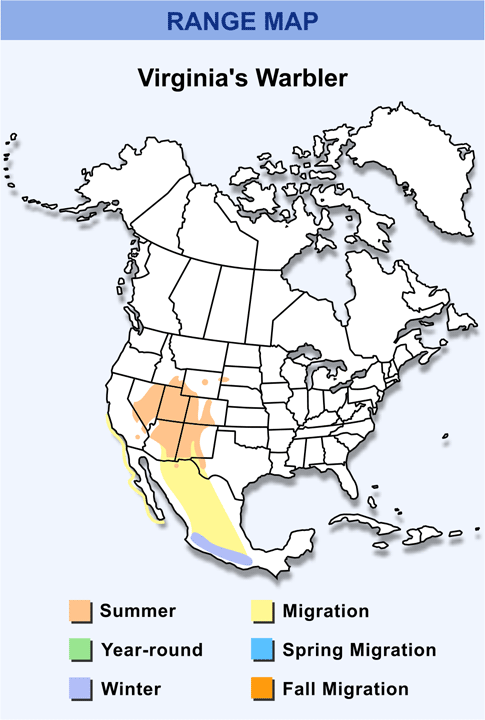
This range map (borrowed from whatbird.com) shows why Virginia's Warbler is such a rarity in these parts. While it has never been recorded on the island before, there is one record from Labrador.

This range map (borrowed from whatbird.com) shows why Virginia’s Warbler is such a rarity in these parts. While it has never been recorded on the island before, there is one record from Labrador.

“What?!?! Where are you??” I said, trying to measure my words. Virginia’s Warbler is a mega-rarity anywhere in northeastern North America, but I know Dave and didn’t doubt for a minute he knew what he was seeing. It turns out he had quick looks at the bird feeding below an apple tree at the base of the White Hills (near Quidi Vidi Lake) and had all but ruled out a dull Nashville Warbler. He was looking for help to confirm the sighting before the troops were called in, although Bruce Mactavish was already enroute. Fortunately, I had the freedom ( and support – thanks to my mother-in-law for watching the girls!) to drop everything and race to Quidi Vidi. Dave called again as I was pulling out of the driveway – he’d seen it again and was convinced!!! I arrived an agonizing ten-minutes later, hot on Bruce’s heels. The bird had disappeared, but hopes were high it would be re-seen.

Long story short, about 45 minutes later Bruce spotted it again briefly with a large flock of Juncos about 200m up the old dirt road we were searching and reinforcements were showing up. We scoured the area all morning without another sighting, and I left to take up family responsibilities at noon. I got a text an hour later that it had been seen again by a handful of people and raced back … just a few minutes too late. The bird was spotted again just before 8:00am the next morning at the original location, but flew off  after just a few moments. A dozen or more birders, myself included, were birding the area all day yesterday to no avail. I went back for an hour early this morning, but no luck. It is likely still around, especially in this relatively mild weather that has moved in, but it is being very elusive.

I am home the rest of this morning, minding a flock of five children while all the women in my family attend some kind of holiday breakfast event — but my mind is on that bird. Chances are I’ll be back there in a few short hours!! And hopefully my next posting will be a celebratory one …

Photo Shoot: Pied-billed Grebe

Despite the perfect November weather (bright, cool & calm!), birding was pretty slow this morning. I birded scenic Cape Spear and checked wandering flocks of juncos & chickadees in Blackhead and the Waterford Valley without finding anything of note. A Lincoln’s Sparrow and two Brown Creepers were my lacklustre highlights.

Cape Spear - the easternmost point in North America.

Cape Spear – the easternmost point in North America.

Swinging by Quidi Vidi on my way home, I noticed the Pied-billed Grebe that has been there this week was hanging out pretty close to shore. It was my first chance to “really” photograph this species (record photos don’t count!), so I enjoyed the few moments I had with this little guy.

PBGR_Nov102013_7860Pied-billed Grebe is an uncommon species in Newfoundland – mostly occurring during fall & early winter (although a pair has bred regularly at a single location in the Codroy Valley for a number of years). I often see one or two a year, but they have always been skittish or hanging out in poor locations for photography. This one was a real treat.

PBGR_Nov102013_7839 PBGR_Nov102013_7855 PBGR_Nov102013_7900PBGR_Nov102013_7800 PBGR_Nov102013_7876 PBGR_Nov102013_7906 PBGR_Nov102013_7911 PIGR_Nov102013_7867

Return of the Prodi-GULL Son …

The smile that crossed my face when reading the local bird reports this morning was a celebratory one … an old friend of sorts has returned! Although I haven’t seen it yet myself, Bruce Mactavish spotted an adult YELLOW-LEGGED GULL sitting in a flock of gulls on a familiar field in Pleasantville (St. John’s) this morning.

Yellow-legged Gull  (this adult photographed in February 2010) was a rare but regular fixture in St. John's every winter for more than a decade ... however it had been almost two years since the last sighting. Until this morning! - Photo: Jared Clarke (February 14, 2010)

Yellow-legged Gull (this adult photographed in February 2010) was a rare but regular fixture in St. John’s every winter for more than a decade … however it had been almost two years since the last sighting. Until this morning!
– Photo: Jared Clarke (February 14, 2010)

Most Yellow-legged Gulls recorded in Newfoundland have been adults, although this intriguing immature gull is considered by many to have been a second-winter Azorean/Atlantis Yellow-legged Gull. - Photo: Jared Clarke (January, 2008)

Most Yellow-legged Gulls recorded in Newfoundland have been adults, although this intriguing immature gull is considered by many to have been a second-winter Azorean/Atlantis Yellow-legged Gull.
– Photo: Jared Clarke (January, 2008)

Birders (and especially the few of us that consider ourselves gull fans) in St. John’s have been spoiled by this species the past dozen or so years. Yellow-legged Gull is a European species that occurs primarily in the eastern Atlantic/Mediterranean and is a very rare wanderer to North America (ABA Code 4). Yet, at least one has shown up here every fall and/or winter since the late 1990’s — enjoyed by local larophiles and a draw for many visitors, listers and even bird tours.There have been as many as three recorded around the city some years, and one usually hangs out for the entire winter. It can be tough to find sometimes amongst the tens of thousands of large gulls that winter here, making it elusive but well worth the hunt. St. John’s has been the only place in North America where this species could be seen regularly and (somewhat) reliably!

The majority (if not all) of Yellow-legged Gulls seen here have been theorized to originate from the Azores, where the Atlantis race has a slightly darker mantle and unique pattern of head streaking in fall/early winter. - Photo: Jared Clarke (December 3, 2010)

The majority (if not all) of Yellow-legged Gulls seen here have been theorized to originate from the Azores, where the Atlantis race has a slightly darker mantle and unique pattern of head streaking in fall/early winter.
– Photo: Jared Clarke (December 3, 2010)

However, something changed two winters ago (2011-12) — an adult Yellow-legged Gull showed up in early fall as expected, although sightings were sporadic and it often went long periods not being seen. Then it disappeared altogether – the last known sighting was on January 15, 2012 when I photographed it bathing with other gulls in some open water at Quidi Vidi lake. Despite lots of searching, often by experienced eyes, it was not seen again that winter. And for the first time in more than twelve years, the species was not recorded in Newfoundland at all the following fall or winter. We were worried!!

Hopefully this bird settles in and stays for a while … certainly there are people out there (near and far) who would love to enjoy it. I know I would, and I’ll be looking every chance I get!

Sometimes it takes experienced eyes to pick out and safely identify a Yellow-legged Gull. Although they can be distinctive among a flock of more typical gulls, there are a few hybrid possibilities that need to be eliminated. The clean white head in winter (or unique pattern of head streaking in fall, see above) and wingtip pattern are important clues to picking out the North American rarity. - Photo: Jared Clarke (December 13, 2009)

Sometimes it takes experienced eyes to pick out and safely identify a Yellow-legged Gull. Although they can be distinctive among a flock of more typical gulls, there are a few hybrid possibilities that need to be eliminated. The clean white head in winter (or unique pattern of head streaking in fall; see above) and wingtip pattern are important clues to picking out this North American rarity.
– Photo: Jared Clarke (December 13, 2009)

No doubt about it -- It's a classy looking gull! - Photo: Jared Clarke (February 14, 2010)

No doubt about it — It’s a classy looking gull!
– Photo: Jared Clarke (February 14, 2010)